
A quantum company moves into AI networking
During training, groups of GPUs compute and then exchange their results. If a transfer takes too long, the cards waiting for it do not advance the model. Available compute capacity alone therefore cannot explain how long a job takes to finish.
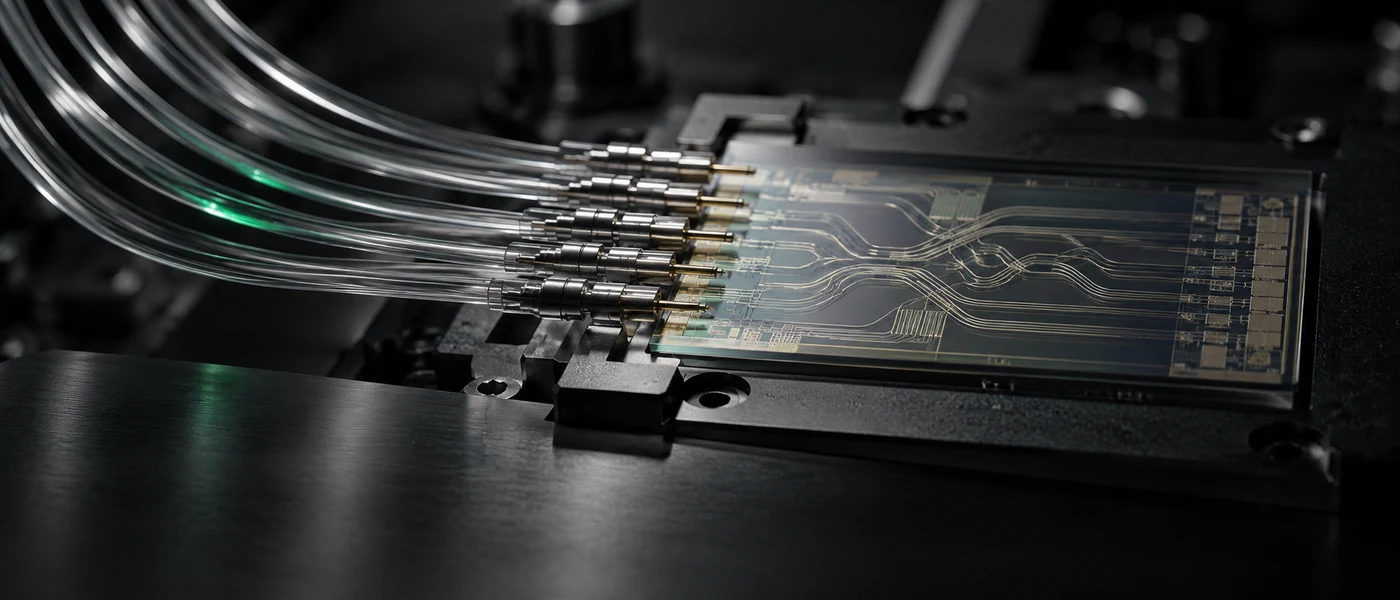
On October 28, 2026, PsiQuantum unveiled an optical switch demonstrator for AI infrastructure. The device has eight inputs and eight outputs. It builds on the photonics platform the company develops for quantum computers, but the data carried here remains classical. Original announcement.
The industrial connection is worth examining. In a photonic quantum system, preserving photons requires limiting losses through components. Waveguides, interfaces and manufacturing processes developed for that purpose can also serve data center networks. The switch changes the path taken by data; it does not execute the model’s multiplications.
To understand what it could change, we need to follow a connection from the machines to the software that decides when to reconfigure it.
Fiber carries the signal; a circuit chooses its destination
Using fiber does not mean that the entire network handles data as light. A packet switch can receive an optical signal, convert it to read and process the data electronically, then transmit it on another link.
An optical circuit switch, or OCS Optical Circuit Switch. It establishes paths between ports while keeping payload data in the optical domain within the device. Reconfiguring paths and carrying data over an established circuit have distinct timing characteristics. , connects optical ports: light arriving from one fiber reaches another without converting the traffic inside the switch. An electrical command selects the path, while the traffic itself remains optical. Transmitters and receivers are still needed at the endpoints. OCP white paper on optical circuit switching.
Consider three groups of accelerators, A, B and C. For one job, A mostly exchanges data with B, so a circuit can connect them. For the next job, A needs C. The controller changes the connection without a technician moving external fibers. Any benefit comes from adapting which machines are connected, rather than automatically increasing interface speed.
PsiQuantum describes its device as strictly non-blocking: a free input can reach a free output without moving established connections. This does not guarantee that a whole cluster can send arbitrary traffic volumes simultaneously. Several requests may want the same output, and the network must still decide how to serve them. PsiQuantum’s technical page.
Optical circuits can complement a packet network
An established circuit reserves a path between ports. It does not inspect each packet to choose another output or buffer traffic while waiting for a destination to become free. This transparency, described in the OCP white paper, explains both its appeal and the work left to surrounding equipment.
In a hybrid architecture, a packet network can continue carrying short or unpredictable exchanges while circuits serve large transfers whose endpoints are known. The controller must decide which flows justify reserving a connection and when to release it. If traffic changes before setup has paid for itself, the selected path may become less useful than expected.
This is an architectural scenario, not a configuration announced by PsiQuantum. It helps define the comparison: measure the complete network, including remaining traffic and recovery mechanisms, rather than assuming every packet switch will be replaced. The component’s port count alone cannot establish how many accelerators will work efficiently together.
Low loss gives the network more optical margin
PsiQuantum reports typical results of 1.2 dB insertion loss, a 40 dB crosstalk figure and reconfiguration in less than 3 milliseconds. These are laboratory results for the 8 × 8 demonstrator. The company is supplying samples to selected prospects and expects to announce commercial products in the coming months.
Decibels express a power ratio. A loss of 1.2 dB leaves about 76% of the original optical power after one passage. Two identical passages would leave roughly 58%, before losses in fibers and other components. This calculation explains why fractions of a decibel matter as paths grow longer; it does not establish a tokens-per-second improvement.
The receiver needs a usable signal to recover the data. Lower loss can help preserve that margin or avoid some compensating measures. Equipment must still be compared at the same wavelengths, with comparable connectors and measurement conditions. A low number on a small demonstrator does not rank every available switch.
Scaling to more ports is a separate test. It adds connections, manufacturing constraints and paths that need characterization. The reported results therefore do not automatically apply to a larger future device. PsiQuantum’s discussed 64 × 64 barium titanate switch belongs to its quantum systems; the company says that material is not required for the AI demonstrator or its planned initial products.
Reconfiguring a network does not mean following every token
Optical circuits already have operational precedents. In TPU v4, Google uses them to connect accelerator blocks and assemble groups suited to jobs. The scheduler can select available resources and route around certain failed components. The described topology remains static during a training run: it is selected for the job, rather than changed on every iteration. TPU v4 paper.
This changes how the benefit should be measured. A reconfigurable network can make a group of machines easier to assemble even when each link retains exactly the same bandwidth. A training job may start sooner or use blocks that would have been difficult to combine in a fixed configuration.
Google also documents optical circuits in Jupiter, where the topology between network blocks can evolve. Its results combine hardware, software control and traffic engineering. They describe a complete architecture, without predicting savings from PsiQuantum’s component. Jupiter Evolving.
Mixture-of-experts models, or MoE Mixture-of-Experts. An architecture where the network is split into many experts, of which a router activates only a small subset per token. Per-token compute follows the number of active parameters; memory follows the total count, since every expert must stay resident in VRAM, ready to be called. , add another difficulty: tokens can activate experts located on different machines. Creating a circuit for each token would be a misleading picture of the solution. MixNet instead investigates how to exploit traffic structure and coordinate circuits with communication software. Its prototype and simulations must be distinguished from industrial products. MixNet, final version.
Three milliseconds can cost more than the transfer
The announced reconfiguration time is not the latency of a signal traversing an established circuit. The path must change and a usable link must be restored. Control, stabilization and equipment recovery can contribute to that delay. For an application, the important quantity is how long critical work is actually blocked.
An example makes the trade-off visible. Suppose a transfer receives 200 Gbit/s of useful throughput on a shared network. A dedicated connection would provide 400 Gbit/s, but preparing it blocks the transfer for 3 ms. These are illustrative assumptions, not PsiQuantum measurements.
The rates correspond to 25 and 50 gigabytes per second in decimal units. For a small 64 MB transfer, the original network finishes in 2.56 ms. The dedicated circuit needs 1.28 ms for transmission plus 3 ms of setup. It therefore finishes later despite its higher bandwidth.
| Volume over one connection | Shared network at 200 Gbit/s | Circuit at 400 Gbit/s, including setup |
|---|---|---|
| 64 MB | 2.56 ms | 4.28 ms |
| 150 MB | 6 ms | 6 ms |
| 1 GB | 40 ms | 23 ms |
Software can improve the result by retaining a circuit for several transfers or preparing it during independent computation. It can also make poor choices: selecting a destination too late, mispredicting traffic or reserving an unused circuit can reduce the benefit. Component speed and scheduling quality therefore need to be evaluated together.
This reasoning is particularly relevant to systems that separate prompt processing from generation. Moving the cache between the two machine groups may justify a circuit if the transfer is large enough and the destination is known in time. A small request may instead suffer from setup added to its critical path.
What a cluster trial needs to show
The optical result is an initial demonstration. The complete link still needs measuring with the chosen interfaces, several active paths and intended operating conditions. Then the network’s effect on applications must be observed: training time, requests completed within their latency target or the ability to reassign machines.
As of November 1, 2026, the examined sources provide no cluster benchmark using PsiQuantum’s demonstrator and no named customer publishing deployment results. The announced stage is sampling, with commercialization still to be specified. Research on the quantum platform documents technical expertise, but does not replace validation of the AI network. Photonics platform published in Nature.
The comparison also needs to cover system cost. Adding an optical layer to an unchanged network adds equipment. Savings arise if that layer allows other equipment to be removed, reduces spending or completes more work with existing resources. Connections, endpoint optics and control all belong in that accounting.
For operators, the first diagnosis remains concrete: are accelerators waiting for communication, or are available machines difficult to group? If so, reconfiguration deserves investigation. PsiQuantum’s announcement provides a hardware candidate for that work. The next proof will be an AI job completed more efficiently through the whole network.
Sources and method
Analysis as of November 1, 2026. Demonstrator performance figures are manufacturer claims. No cluster speedup, cost per token or availability result is extrapolated from optical loss.
- Documented facts and attributed measurements: PsiQuantum’s October 28 announcement and active technical page. The full convention for the crosstalk figure is not published; it is retained with attribution, without an arbitrary percentage conversion.
- Mechanisms and trade-offs: OCP, April 2026 and Mission Apollo. The white paper includes vendor contributions; Google’s publications describe their authors’ systems.
- Precedents and research: TPU v4, Jupiter Evolving and MixNet v4. Their results are not transferred to PsiQuantum’s component.
- Technology lineage: Nature, PsiQuantum’s photonics platform. This work concerns the quantum platform, not qualification of the new AI demonstrator.
- Illustrative calculations: the remaining power fraction is
10^(-loss_dB/10), approximately 76% for 1.2 dB and 58% for 2.4 dB. The transfer example comparesD / 25 GB/swith0.003 s + D / 50 GB/s, ignoring effects on other communications. The 3 ms is an assumption for total unhidden overhead, not a direct substitution of the announced actuation time.