
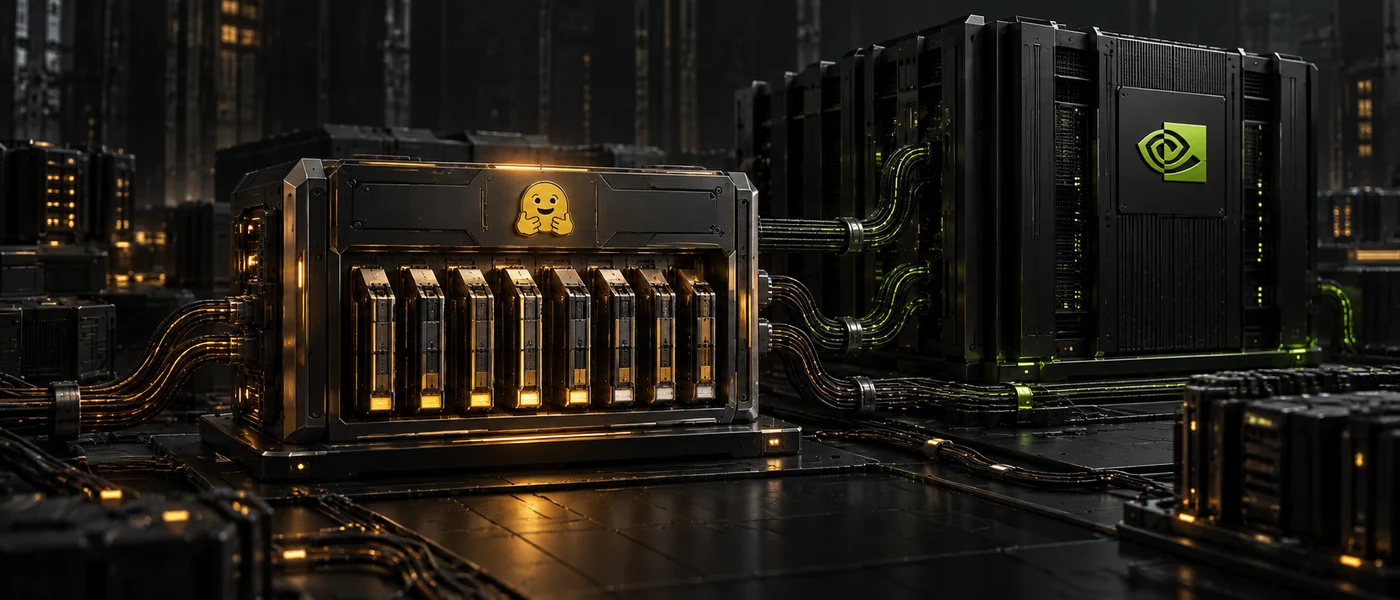
NVIDIA has signed an agreement to acquire Hugging Face, the platform where developers find, share and deploy AI models. The regulatory filing separates approximately $11.9 billion for shareholders from up to $1 billion to retain employees joining the group. Closing is expected in the first half of 2027, subject to conditions including regulatory approvals. SEC filing.
The deal would connect a compute supplier with an intermediary that helps developers choose what to run. NVIDIA commits to keeping the platform open and compatible with other chip vendors. Hugging Face co-founder Clément Delangue presents the transaction as a way to increase resources for the community while continuing to operate a neutral platform. CNBC interview.
Those commitments matter. File access and distribution power can nevertheless move in different directions. A model may remain downloadable while trying it, hosting it and paying for its execution become more convenient within one environment.
A model page can become the start of a service contract
Consider an illustrative example. A team wants to add an assistant to its application. It opens a model page on Hugging Face, checks the licence and advertised capabilities, then tries the model through an interface accessible from the Hub.
If the trial works, the team can continue with an integrated inference provider. That provider runs the model on its infrastructure while Hugging Face makes the available services easier to access. Discovery, testing and usage tracking can become successive steps in one workflow. The Hub Integration documentation describes these connections between the catalogue and execution.
The team may never have made a deliberate decision to depend on the platform long term. It selected a series of convenient options. Moving later remains possible, but requires checking another API, its limits, pricing and availability, then reorganising operations.
That is the acquisition’s strategic significance. A platform operator can influence which options developers see immediately and how much work they require. Files do not have to disappear for some paths to become easier than others. This is an analysis of the platform’s position, not evidence that it has already exercised favouritism.
Who chooses when the developer leaves it on auto?
Routing makes the issue concrete. When an application requests a response without specifying a provider, some component must decide where the work goes.
In the inspected Python version, automatic chat mode delegates that decision to a server-side router. For other tasks, the client uses a provider list. These are distinct paths. The huggingface_hub v1.32.0 source establishes that separation without revealing all the server’s rules.
The chat documentation describes a default selection based on throughput, measured in tokens, the pieces of text a model produces, per second. It also offers a pricing policy and a policy following user preferences. Developers can explicitly select a provider. Pinned documentation.
Even a simple criterion expresses a service choice. Throughput alone does not tell you how long the first word takes to arrive. The price of an output token does not describe the whole bill for an application that sends long inputs. Choosing and presenting these criteria gives the intermediary a practical responsibility.
Nothing in the reviewed material demonstrates that routing currently favours NVIDIA. The documented Cerebras integration also shows a path using other hardware. The issue is future control over those choices and how the promised neutrality can be checked.
Buying the platform does not transfer every model
The Hugging Face terms distinguish the service from the content its authors upload. A change in the company’s ownership would not automatically assign NVIDIA every right to the hosted models, datasets and contributions.
Their licences still govern reuse. Downloadable weights, the parameters a model learns during training, do not necessarily permit every use. Conversely, permissively licensed code can provide a basis for continuing elsewhere, independently of the platform.
Hugging Face documents how to download models. That exit matters: a team can retain the files and operate its own environment. It still needs the runtime, hardware and expertise to deliver the same service.
Model portability and operational portability are separate questions. Our inference runtime comparison, in French explains part of that technical choice. Weights do not include enterprise accounts, monitoring or availability commitments. A provider can become more valuable by handling that work even when the underlying files stay accessible.
NVIDIA can also benefit from keeping the platform open
A story of progressive closure is easy to tell, but does not fully explain the buyer’s incentives. If more teams use open models, they will need compute to adapt and serve them. NVIDIA could seek to expand that market while preserving users’ choice of infrastructure.
That gives substance to Delangue’s argument. More resources could improve hosting, maintenance and integrations. A platform that remains useful on competing hardware could attract a larger community than a service restricted to one vendor.
The potential benefit leaves governance questions to answer. A promise of compatibility does not determine which projects receive maintenance resources, how quickly new hardware gets integrated or which offers receive the most visibility. Routine allocation decisions can matter as much as an explicit restriction.
Data handling needs the same precision. Inference Providers documentation says the bodies of routed requests and responses are not stored. The announced acquisition therefore does not establish that NVIDIA already receives users’ prompts. Access and processing rules must be assessed through their actual provisions. Routing security policy.
Neutrality will be tested in everyday use
For developers, keeping copies of useful models protects part of their autonomy. Knowing who executes requests, and what would have to change to switch providers, protects another part.
The evidence to watch after the commitments is practical: access to competing providers, integration quality, pricing changes and transparency around automatic selection. Keeping the download button will be necessary, but it will not settle those decisions.
NVIDIA seeks to acquire a place where choosing a model can become choosing infrastructure. That connection gives the agreement its significance. Open AI can retain its files while the services that make those files convenient become more concentrated.
Sources and method
Research is current to September 20, 2026. The agreement, amounts and expected timetable come from NVIDIA’s 8-K. This English edition uses the original US-dollar figures and keeps shareholder consideration separate from employee retention payments. The support and neutrality commitments are attributed to the CNBC interview, whose transcript is labelled unofficial.
The routing analysis uses the Python v1.32.0 source and fixed documentation revision linked above. Archived evidence files were checked against their SHA-256 manifest. No inference test or server audit was performed. A provider’s presence in the documentation does not guarantee availability for every model and account.
The team’s journey is a constructed example. Potential effects on distribution and switching costs are editorial analysis, not observed discriminatory practices. Transaction status reflects the sources available on September 20, 2026.