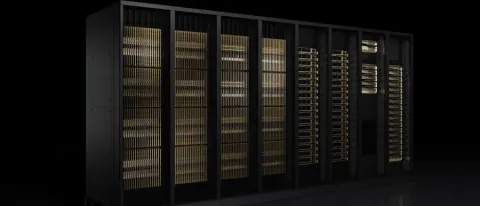


A data centre can have its buildings and equipment ready without access to all the electrical power it wants to use. Before allowing it to ramp up, the grid must be able to supply it when demand is high and some equipment is unavailable. A reasonable annual energy budget does not resolve that constraint at a particular hour.
On September 16, Emerald AI, Google and NVIDIA announced the AI Energy Management Alliance, or AEMA. They propose giving greater recognition to facilities that can reduce their draw when the grid needs relief. In exchange for verifiable commitments, these data centres could obtain faster or larger connections. Alliance announcement.
For the companies, the immediate benefit would be using their computing capacity sooner. The grid faces a more demanding question: can it rely on the promised reduction strongly enough to build it into investment and connection decisions?
The promise has to show up at the meter
An operator can reduce its draw in several ways. It can postpone training, slow work that tolerates delay or send requests to another region. A battery can supply some electricity without changing server activity. Associated generation can also reduce demand on the grid.
These options have different effects on compute, costs and emissions. What they share is a reduction at the right location during a period when the grid needs it. AEMA therefore advocates criteria for response, duration and predictability, regardless of the technique used.
Duration changes the assessment. A battery holds a limited amount of energy; deferred work still has a deadline; a destination region can run short of capacity too. Responding quickly does not guarantee that a reduction can last several hours or be repeated the following day.
Recovery also has to be counted. If training later consumes the energy it avoided during a peak, demand has shifted in time. That can provide a valuable grid service without reducing annual consumption. When and where computation happens become part of the electricity service.
GPUs can respond within the workload’s constraints
A trial in Phoenix provides a concrete starting point. On a cluster of 256 A100 GPU Graphics Processing Unit. A processor designed to run many computations in parallel, used for tasks including training and running AI models. , researchers reported a 25% power reduction for three hours while meeting the service guarantees defined for their workloads. The work appeared in Nature Energy in December 2025. Publication record.
Meeting those guarantees does not mean every task ran at exactly its original speed. The protocol categorises work according to acceptable slowdowns and protects the most sensitive tasks. The measurement detailed in the preprint concerns GPU power; it does not by itself cover cooling and every other load at the facility. Phoenix protocol.
The mechanism is straightforward. The scheduler, the software that assigns resources to tasks, uses the room left by their deadlines and priorities. The more flexibility customer commitments allow, the more it can adjust activity. A service that must respond immediately and a data-processing job due tomorrow give it different options.
Later trials examine a broader set of conditions. A June preprint describes repeated instructions on a London cluster and inference shifted between Ashburn and Chicago. In the latter case, requests come from a load-generation tool and the receiving site draws more power as it takes on work. This demonstrates load shifting with measurable consequences elsewhere. June study.
The results make the technical proposal credible. The guarantee required from a large site is broader: availability during actual grid constraints, cooling behaviour, recovery capacity and delivery over time.
Contracts begin to price that flexibility
In March, Google announced a portfolio of one gigawatt of demand-response capacity incorporated into long-term contracts. That is an aggregate commitment. It does not prove that a gigawatt would be available simultaneously or that such a reduction has already been activated. Google announcement.
A more specific document shows how a promise can become an operating constraint. The March supply agreement between DTE and Google sets out consequences if certain associated agreements, including demand reduction, terminate or are not honoured. The parties may have to revisit the supply ramp or responsibility for additional costs. Public contract, sections 2.3 and 2.4.
That relationship gives the issue commercial weight. The operator’s commitments can affect the power it receives and what it pays. The text also includes conditions precedent, including approvals. The documents reviewed do not establish that the entire arrangement is operational.
For the owner of the GPUs, accepting the constraint may still make sense. A facility that starts operating sooner under agreed limits could complete more work than one waiting for unrestricted capacity. That is a plausible economic argument whose outcome depends on the delay avoided and the actual cost of interruptions.
Four distinct states
| State | What it establishes | What it does not prove |
|---|---|---|
| Committed | Capacity appears in an announcement or contract. | That it is available today. |
| Connected | The site receives electricity. | That all planned flexibility is qualified. |
| Available | A reduction can be delivered under specified conditions. | That it has been delivered. |
| Activated | A reduction has been requested and measured. | That it will be available for every future call. |
This distinction extends our analysis of announced capacity and capacity actually connected.
Other customers need to be able to check the benefit
A benefit for the data centre does not establish a benefit for the grid. A new facility can make better use of some assets while requiring upgrades elsewhere. Its flexibility must relieve the equipment that actually limits its connection.
Duke’s national model gives an indication of the potential. Under its assumptions, it estimates that 98 GW of new load could be accommodated with average curtailment equivalent to 0.5% of that load’s potential annual energy. That fraction measures energy, not directly the number of disrupted hours. The model is not a local authorisation to connect that capacity. Duke report.
Contracts also raise transparency questions. In Indiana, the regulator approved an agreement involving I&M and Google while opening a subdocket on confidentiality of information including curtailment commitments and certain compensation terms. Approval can therefore coexist with a dispute about what other customers can scrutinise. Order 46276.
Assessing the benefit requires knowing the enforceable reduction, its timing, measurement rules and consequences of non-performance. Without that detail, an announced volume can blur what is promised, what is available and what has been delivered.
Grid access becomes part of running compute
AEMA wants flexibility recognised in connection decisions. Trials show that AI workloads can follow power instructions; contracts are beginning to link that ability to supply conditions. Bringing those strands together is the strategic development in this story.
An operator must compare earlier access to electricity with the operating freedom it gives up. The grid must verify that this freedom can actually be exercised at the critical moment, then allocate the remaining costs.
The next announcements should therefore be read through their obligations: who issues the instruction, how much power can be removed, for how long and with what consequence if the data centre fails? Those clauses determine whether the promise from Google, NVIDIA and Emerald AI becomes capacity the grid can rely on.
Sources and method
This analysis uses documents reviewed as of September 20, 2026. The alliance’s objectives are attributed to its announcement; the contractual gigawatt to Google. These announcements do not establish simultaneous activation of the capacity.
Phoenix measurements are reported by the authors. Publication status was checked against the Nature Energy record, while protocol details come from the preprint. The June 2026 study is treated as a preprint. The research teams include parties involved in developing these solutions; LeCompute reproduced none of the trials.
The DTE contract and Indiana order concern separate situations. The Duke report is a modelling exercise, not an inventory of connectable capacity. Economic consequences described here are conditional analysis. Contract status reflects the documents available on September 20, 2026.