A haiku that checks an entire chain
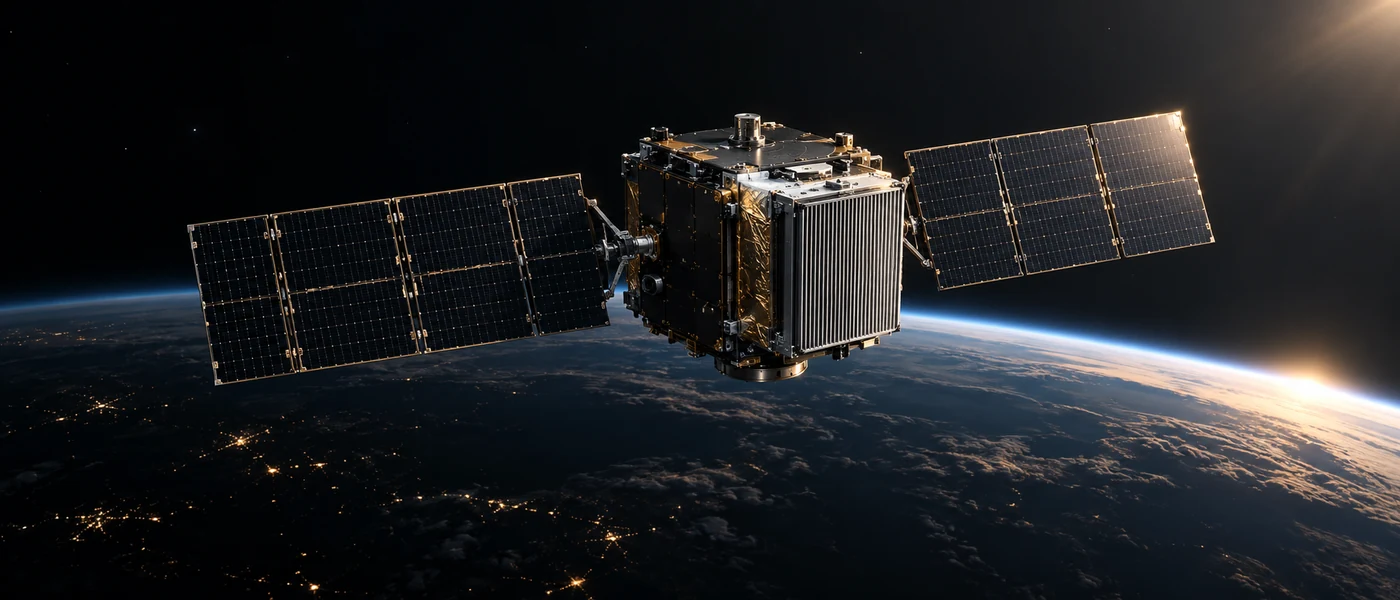
A ground team sends a satellite an instruction: write a haiku about being in space. Onboard, Gemma 4 handles the request on a TPU Tensor Processing Unit. Google's ML acceleration ASIC. Not a lone chip but a network: chips linked directly by the ICI interconnect in a torus topology, each combining TensorCores (dense matmul) and SparseCores (embeddings, collectives). It only knows how to talk to the XLA compiler. , Google’s accelerator for neural networks. The text returns to Earth during a pass over Svalbard, Norway.
Google announced this first response on October 30, 2026. The Project Suncatcher prototype, developed with Planet, had launched on October 1. Between those dates, the team commissioned the equipment and conducted its first computing tests. Google’s announcement.
For the model, producing a few lines is a modest test of language capability. For the system, it is useful evidence. A command reached the satellite, the hardware ran a model after launch and the response was recovered. The next question is how long that chain can work, with which errors and interruptions.
Solar electricity needs a power plant onboard
The appeal of orbital computing starts with a constraint on Earth: a data center needs a grid connection, electricity and land suitable for its equipment. With Suncatcher, Google is exploring infrastructure powered by solar panels in space. The project targets an orbital geometry favorable to prolonged sunlight exposure. Program overview.
That move changes the spending involved. Panels must be manufactured, launched, deployed and oriented. The satellite also uses electricity for communications, control and onboard equipment. The power generated by its cells is therefore not entirely available to accelerators.
Peak power and available energy must also be kept separate. Consider a hypothetical generator capable of supplying at most 1 kilowatt of electrical power. Even if it maintained that maximum for a full day, it would produce only 24 kilowatt-hours. Eclipses, conversion losses and the satellite’s own needs would reduce the energy available for computing. This example explains the units; it does not reconstruct Suncatcher’s power budget.
A battery can support a computing session that draws more power than the solar panels are producing at that instant. It then needs recharging. How frequently those sessions can occur depends on energy consumed and recovered as well as the chip’s rated power. Panels, batteries and converters must also retain enough capacity at the end of the mission. NASA’s small spacecraft power overview.
Orbit and workload therefore need to be considered together. Good sunlight exposure can improve the energy budget without guaranteeing continuous computation.
In a vacuum, heat needs a surface to leave from
A processor turns most of the energy it consumes into heat. On Earth, a cooling system carries that heat to the air or another heat sink. Outside a satellite, the absence of air removes ambient convection: a fan cannot expel heat into a vacuum.
Heat must first travel from the component to a radiator through conduction or an internal heat transport system. It then leaves that surface as infrared radiation. Heat pipes and fluid loops remain possible onboard; the final step into the environment changes. Depending on its orientation, the radiator also receives energy from the Sun and Earth. NASA’s thermal control overview.
Physics gives a useful scale. Assume an ideal surface at 300 kelvins, about 27 °C, with an emissivity of 0.9, facing a cold background and receiving no incoming radiation. The Stefan-Boltzmann law gives approximately 413 watts radiated per square meter. Rejecting one kilowatt would therefore require about 2.4 m² of emitting surface under those conditions. This calculation does not describe Google’s radiator: it leaves out external heat input and thermal resistance between the chip and the surface.
A higher temperature strongly increases radiation. It must remain compatible with the components and heat transport circuit, however. Simply letting the chip get hotter does not produce a better system.
A short run can also store heat temporarily in the structure. If the satellite generates more heat than it rejects, its temperature rises. It must then reduce the load or wait. Completing a computation and sustaining that load are different results. Google says it tested its cooling system in a thermal vacuum chamber; orbital monitoring must now establish its behavior in flight. Suncatcher test overview.
The battery and radiator must sustain the same schedule
Suppose the satellite recovers enough energy between sessions to recharge its battery. Its temperature may still be too high for the next session. If each run leaves more heat in the structure than the rest period removes, the system eventually has to slow down despite having electrical energy available.
The reverse is possible too: the hardware may have cooled before the battery has sufficiently recharged. A sustainable schedule must satisfy both budgets over the same sequence of computing and rest periods. Communications and other equipment also consume energy and contribute to the heat that must be rejected. This analysis follows the thermal balance described by NASA, without assigning a particular duty cycle to Suncatcher.
The next orbital report would therefore benefit from showing several complete cycles of computation, cooling and recharging, with temperatures and useful work delivered. That would tell us more than an isolated activation duration. Repeatability is what could turn a one-off demonstration into a service capacity.
A processor that responds can still be wrong
Launch brings vibration. Orbit adds radiation and temperature changes. An accelerator originally designed for a data center needs qualification for these conditions beyond demonstrating that it works in a terrestrial server.
Radiation has two distinct kinds of effects to consider. Accumulated exposure can degrade hardware. A particle can also temporarily disturb an electronic state: the system may continue running while producing incorrect data. Checking that a board powers on does not establish computational correctness. NASA’s small spacecraft avionics overview.
Google’s ground tests exposed TPUs to a proton beam. Its scientific study describes the conditions and extrapolations to an orbital environment. Those experiments help prepare a mission; they cannot replace extended observation of all the assembled equipment. Suncatcher study, version 2.
A system can use memory error correction, checks, restarts or redundant copies. These are architectural options, without assuming the prototype’s exact protections. They consume resources themselves and may require work to be repeated. A future orbital data center must be judged on the correct results actually delivered, including interruptions and recovery.
Sending a poem does not measure a data center network
The satellite-to-Earth link carries an instruction and its response. A constellation sharing one model would have a second need: communication between accelerators during computation. These networks serve different purposes.
| Possible workload | Required communication | Potential service constraint |
|---|---|---|
| Request executed entirely onboard | Input, response and prior model loading | Ground access and waiting for an available link |
| Analysis of images captured in space | Sensor data to compute, then selected results to the ground | Local capacity and the amount of information to transmit |
| Model distributed across satellites | Intermediate information between accelerators during generation | Inter-satellite bandwidth, delay and stability |
| Distributed training | Repeated exchanges and compute synchronization | Group continuity and communication overhead |
These scenarios describe possible architectures. Suncatcher’s haiku does not demonstrate that they have been implemented.
Even for the ground link alone, peak bandwidth does not establish daily delivered volume. A station must be visible, contact established and the connection usable. A response might be computed quickly and then wait to be downlinked. Additional stations or relays can expand coverage, with costs of their own.
Between satellites, terminals must maintain their pointing as spacecraft move and vibrate. A distributed model may wait for another accelerator at each step, turning a brief link interruption into a computing interruption. Google plans a test with two interconnected satellites in 2027. That milestone will address a problem closer to cluster operation than receiving text from a single spacecraft.
The first market may depend on where data originates
If images are captured onboard, analyzing them close to the sensor can avoid transmitting every raw byte. The satellite can return alerts, regions of interest or compact results. That computation has value because of the network traffic saved, even if it does not beat a terrestrial server on cost per operation.
Serving an Earth-based application instead requires inputs to travel into space and results to return. The business case must account for links, stations, availability and hardware replacement. A working accelerator may become less attractive as newer terrestrial generations arrive; replacing it in orbit is a different operation from swapping a server.
Suncatcher thus explores a system trade-off. Some grid and land constraints are exchanged for launch mass, deployable surfaces and equipment that must last. Dividing a research mission’s cost by its first poem says little about that trade-off. A credible cost per token would require the total useful computation delivered over the system’s lifetime.
The next decisive data will concern sustained operation, temperatures, recovered errors and communication availability. The first received text makes the experiment tangible. Progress toward a data center will be measured by how long the system can keep answering correctly.
Sources and method
Analysis as of November 1, 2026. The announcements describe operator-reported results, without providing access to an independent audit of flight logs. Usage scenarios are an analysis of constraints, not a list of capabilities already demonstrated.
- Documented event: Google’s October 30 first-response announcement and Planet’s October 1 launch announcement. The announcement names Gemma 4 without publishing a variant or generation timing.
- Program and tests: Google Research’s initial overview, preparatory tests and scientific study, version 2. Simulations and ground tests are not presented as in-orbit results.
- Physical references: NASA on power, thermal control and avionics.
- Illustrative assumptions:
1 kW × 24 h = 24 kWh. For radiation,P/A = εσT⁴, withε = 0.9,σ = 5.670374419 × 10⁻⁸ W·m⁻²·K⁻⁴andT = 300 K, gives approximately413 W/m², then1,000 / 413 ≈ 2.4 m². This is an ideal emitting area, not a deployed panel dimension or Suncatcher specification. - Checking a media claim: the twenty minutes reported by TechCrunch on October 30 concern hardware activation. No poem generation time is inferred from them.